OLFACTORY ART
Scent is the most ephemeral yet deeply immersive form of artistic expression.
My olfactory compositions serve as invisible structures, shaping spatial and emotional perception beyond the visual and auditory realms.
Olfactory Compositions – Custom-blended scent works that evoke an expanded sense of perception.
Interdisciplinary Connections – Scent as an element that forms a dialogue between the tangible and the intangible.
Olfactory art is not just about fragrance itself, which is a work of spacial architecture by nature, but also about how scent moves through space, how it lingers and transforms, how it evokes memory and emotion in ways no other medium can. I explore how the invisible nature of scent sculpts experience and perception.
I create complementary scent compositions for my musical works, which are presented in an installative manner, immersing audiences in a multi-sensory experience. Two pieces that have been purposefully conceived for both sound and scent are my Olfactospheres and my Violin Concerto No. 1. These works exemplify how scent can function as an integral, compositional element within a structured artistic framework, expanding the traditional boundaries of performance and perception.
IN PRACTICE
Scent installation
for Violin Concerto No. 1
at Örebro Konserthus
in Sweden (2025)
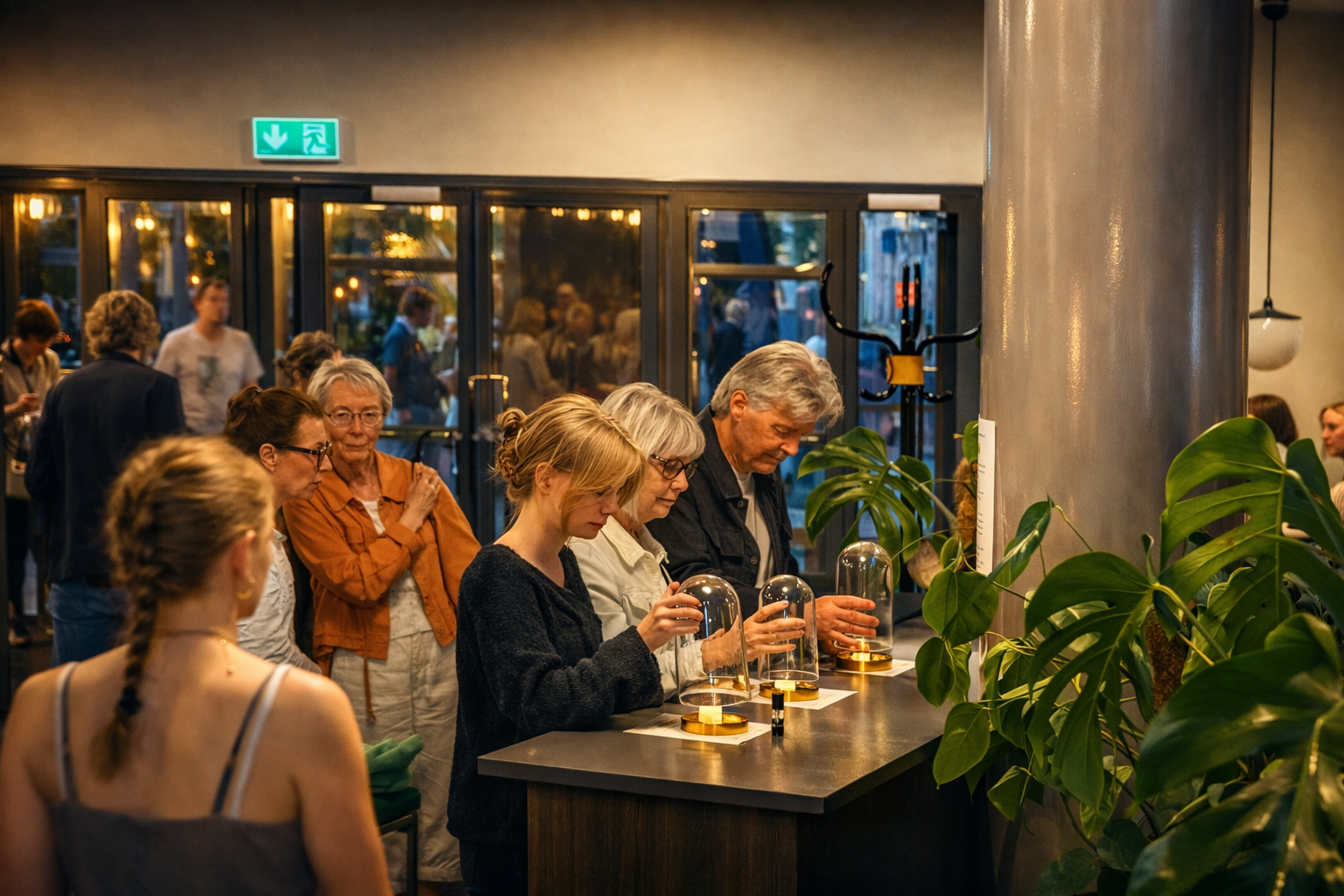
Each movement of the Violin Concerto is accompanied by a custom-composed scent, forming a synesthetic triad of sound, image, and fragrance. These perfumes are olfactory translations of the emotional and structural essence of each movement — composed in parallel with the music and visuals. Visitors are invited to experience the work as a living, breathing environment: a multisensory architecture where scent becomes a carrier for memory and thus transforms its ephemeral nature into sensory tangibility.
The scent installation was placed in the foyer to meet the audience before the music begins and again during the intermission following the concerto, opening a sensory threshold rather than accompanying the performance from within. The violin concerto explores time, memory, and perception as overlapping fields rather than linear progression. By engaging scent — the sense most closely linked to involuntary memory — visitors enter a state of heightened attention, which causes perception to become more porous. The foyer thus becomes an antechamber of listening, preparing the body to encounter the music through a more sensual and physically activated approach.